Decksy surveyed 1,036 U.S. teachers and found that 71% prepare lesson presentations outside scheduled working hours at least sometimes. The research examined how educators prepare lesson presentations, where they spend the most time, and whether artificial intelligence helps reduce their workload.
Key Findings
58% said structuring a lesson was one of the most time-consuming preparation tasks.
69% spend another 30 minutes or more creating supporting materials after their presentations are ready.
82% of teachers who use AI report saving at least one hour per week, while 37% save three hours or more.
41% would not trust AI's factual accuracy without reviewing the results themselves.
43% said they would use two hours saved by AI to give students more individual attention.
Lesson preparation extends beyond working hours
According to the survey, 70% of teachers create or significantly update at least three lesson presentations in a typical week, while 14% prepare 11 or more. Half of the respondents spend at least one hour preparing a single classroom-ready presentation.
Only 22% of teachers reported preparing presentations exclusively during scheduled working hours. For 42%, most preparation happens during working hours but occasionally extends into personal time.
The research also identified lesson structure as a major challenge. 58% of respondents selected organizing the structure of a lesson as one of the most time-consuming preparation activities, followed by content development at 56%.
Supporting materials add to the workload
Completing a presentation does not necessarily mean completing lesson preparation.
The survey found that 59% of teachers create worksheets after preparing presentations, 46% prepare handouts, and 44% develop quizzes or assessments. Another 33% prepare homework or follow-up activities.
Overall, 69% spend at least another 30 minutes creating supporting materials after their presentations are ready.
Teachers also rely on existing resources when building lessons. Personal notes are the most common starting point at 59%, followed by PDFs at 57% and Word documents at 54%. Only 26% reported starting lesson presentations with an AI prompt.
AI saves preparation time, but accuracy remains a concern
AI is already part of the workflow for most respondents. 70% said they use AI models for lesson planning regularly or occasionally. As professional development programs increasingly incorporate AI tools, teachers learn to use these tools to streamline administrative tasks while maintaining control over factual accuracy.
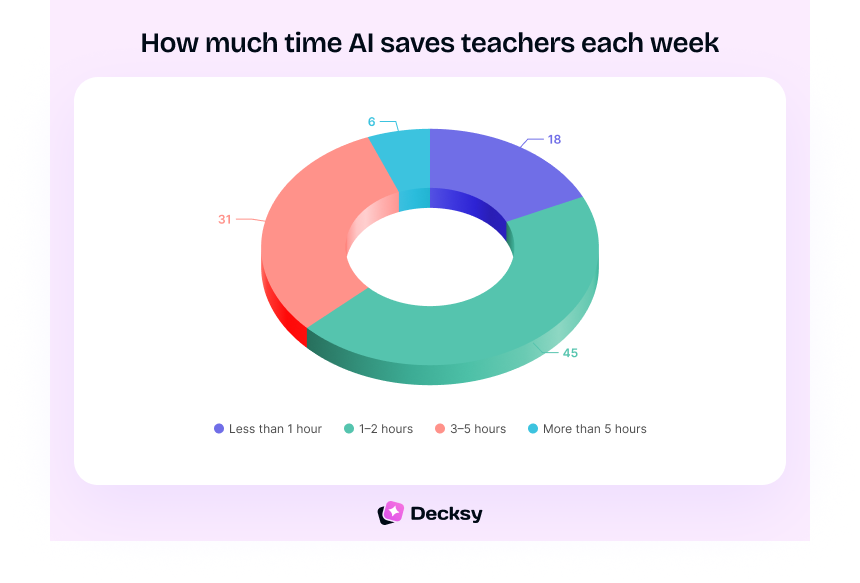
Among AI users, 82% of educators said it saves them at least one hour per week. 37% of teachers who use AI save three hours or more per week.
However, the findings also show limitations in educators' trust in AI-generated material. While 54% of AI users employ these tools for fact-checking lesson materials, 41% of surveyed teachers said they would not trust AI's factual accuracy without reviewing the results themselves. Only 12% said they would trust AI without additional review.
Decksy asked how teachers would use two hours saved through AI-assisted lesson preparation. 43% of respondents said they would dedicate that time to providing students with more individual attention.
The bottom line
The findings describe a workflow in which teachers use AI to reduce preparation time while retaining responsibility for lesson content, factual accuracy, and classroom instruction.
AI tools are already reducing some of that load. Yet the role of teachers does not seem to be to let technology take over the class. Instead, they use technology to speed up certain aspects of the process while maintaining control over accuracy and the class experience.
Methodology
The study was conducted by Decksy among 1,036 full-time and part-time U.S. teachers aged 23–65. Data were collected through online panels using Random Device Engagement (RDE). Percentages were rounded to the nearest whole number.